Bits of History – Art
Jacques
Le Goff:
…the flowering of one of the
finest European artistic traditions
of the Early Middle Ages…
From his foreword to “Croatia
in the Middle Ages:
A Cultural Survey”


On the territory of Croatia there exist many remains of
the Ancient Greek and Roman civilizations. Let us mention
only
- the beautiful palace of the Roman Emperor Diocletian (4th century) in Split (the city and the palace have been bombed in 1991 during the Greater Serbian aggression),
- the ancient city of Salona
near Split, the most important Early Christian archeological site after
Rome (see a photo on the left)
It is described in a monograph of the famous Danish architect and archeologist Ejnar Dyggve, “History of Salonitian Christianity”, Oslo, 1951 (Croatian edition by Knjizevni krug, Split, 1996). - the ancient city of Narona near Metkovic,
- and the Arena in Pula (1st century, 6ht largest in the world, 23,000 seats).
Very important remain of Byzantine art in Croatia is the Euphrasius Basilica in Porec, built in the 6th century.
There are numerous traces
of much older civilizations
throughout
Croatia. Especially interesting is the Vucedol
Culture (Early Bronze Age,
3000-2200 B.C.), discovered in the
region near Vukovar,
contemporary to the Ancient Egypt (the Old
Kingdom), the Sumerian civilization,
the Old Troy.
On the photo you can see the famous Vucedol
Dove, a bird-shaped
cult vessel, lavishly
incrusted. From ornaments of some pots we know that the Vucedol
culture had the oldest
calendar
in Europe, older (though less
sophisticated) than the one in
Stonehenge. See [Durman].
Numerous
artifacts of the Vucedol culture
(including some of the most valuable) have been robbed during the
Greater Serbian aggression on Croatia in 1991. This important
Croatian cultural heritage is still in Yugoslavia.
REMARK. The Netscape virtual tutorial offers several examples of some of the most beautiful web-pages, including an excellent presentation of the Diocletian palace in Split by Michael Greenhalgh from the Australian National University, Canberra. Unfortunately, I was not able to convince the author of this exceptional web-page that it would be more convenient to note that the state in which the city of Split lies is Croatia (Croatized already in the 9th century, a part of the Croatian state in the 10th century, during the King Tomislav), rather than ex-Yugoslavia (which was also true, but only for 68 years!).
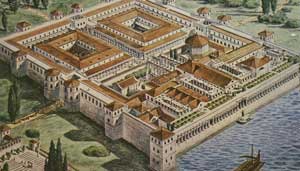
An important monograph describing Diocletian’s Palace in Split is “Ruins of the Palace of the Emperor Diocletian at Spalatro in Dalmatia” written by Robert Adam in 1764, with his main associate Ch.L. Clerisseau. The author, an outstanding Scottish architect, mentions the beauty of Split and its favorable position and climate, stating that “in the whole of the wide Roman Empire, not a single region could offer Diocletian a more marvelous place to withdraw to for a life of peace”. He designed several buildings in the style of Diocletian’s palace (Syon House in Middlesex, Kedleston in Derbyshire, Adelphy Palace in London). Influences of his book can be seen even in St. Petersburg in Russia and in Virginia in the USA.
The octagonal Mausoleum of the Roman Emperor Diocletian was transformed into the Christian church of St Dominius (Dujam) already in the 7th century, representing very probably the oldest cathedral in the world. According to Danish scientist Ejnar Dyggve, St Dominius (Dujam), the earliest known bishop of Salona (4th century), originated from Syria or Mesopotamia. Local Split tradition also confirms this.
It is little known that the founder of the Republic of San Marino is St. Marinus, stone-carver born on the beautiful island of Rab in the 3rd century. Being a Christian, he had to escape to Rimini with his boat due to Roman persecutions of Christians during Diocletian’s time. San Marino and the Rab are fraternal towns. Every year a joint festival is held alternately in Rab and San Marino.
Another important archeological site is Bribirska glavica near the town of Skradin, where Croatian dignitaries Subic-Bribirski (later known as Subic-Zrinski) had their seat. The place is near the town of Skradin. First archeological excavations were undertaken by fra Lujo Marun, and then Stjepan Gunjaca. Settled already by Illyrians, during early Roman times it was called Varvaria, and had the status of municipium. In 14th century it was important fortress during the reign of Pavao Subic, Croatian Ban (governor) and ruler of Bosnia. In the period of 1991-1995 Greater Serbian aggression, this outstanding place has been used for bombing and shelling of Croatian towns and villages, and left completely devastated. It was liberated during the Storm operation in 1995.
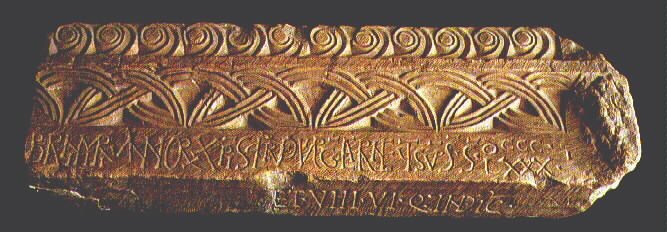
The
beginnings of the Croatian art are represented by a rich ornamentation in interlace
pattern. You can
see an important monument with the interlace pattern which contains the
name of Duke
Branimir (9th century).

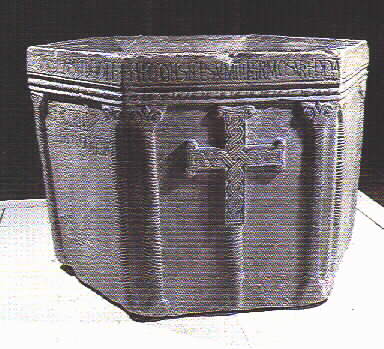
One of the earliest Croatian cultural monuments is a baptismal font of Prince Viseslav from Nin (around 800 AD), with a nice interlace cross. It contains the following Latin text, full of interesting ligatures: HEC FONS NEMPE SUMIT INFIRMOS, UT REDDAT ILLUMINATOS. HIC EXPIANT SCELERA SUA, QUOD DE PRIMO SUMPSERUNT PARENTE, UT EFFICIANTUR CHRISTICOLE SALUBRITER CONFITENDO TRINUM PERHENNE. HOC IOHANNES PRESBITER SUB TEMPORE VUISSISCLAVO DUCI OPUS BENE COMPOSUIT DEVOTE, IN HONORE VIDELICET SANCTI IOHANNIS BAPTISTE, UT INTERCEDAT PRO EO CLIENTULOQUE SUO.
Croatian translation: Ovaj izvor naime prima slabe, da ih učini prosvijetljenima. Ovdje se peru od svojih zločina sto su ih primili od svog prvog roditelja, da postanu kršćani spasonosno ispovijedajući vječno Trojstvo. Ovo djelo pobožno učini svećenik Ivan u vrijeme kneza Višeslava, i to u čast sv. Ivana Krstitelja, da zagovara njega i njegova štićenika.

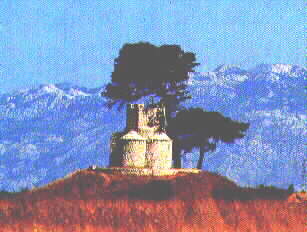
A
special
importance have about 150 Pre-Romanesque Croatian churches (9th to 11th
century), mostly along the coast. About 15 of them are well preserved
(some of them completely destroyed during the Greater Serbian
aggression in 1991-1995). Probably the best example of old Croatian
church architecture is the Pre-Romanesque Chapel of Holy Cross in Nin
built around 800 AD (Sveti Kriz; see on the right; on the left is the
small church of Sveti Nikola). The British architect Thomas Graham
Jackson called it in 1887 the smallest
cathedral in the Christianity,
because of its monumental architectural conception.
An unofficial estimate claims there are about 10,000 fragments of interlace sculpture scattered all over Croatia, see [Goss], p. 32.
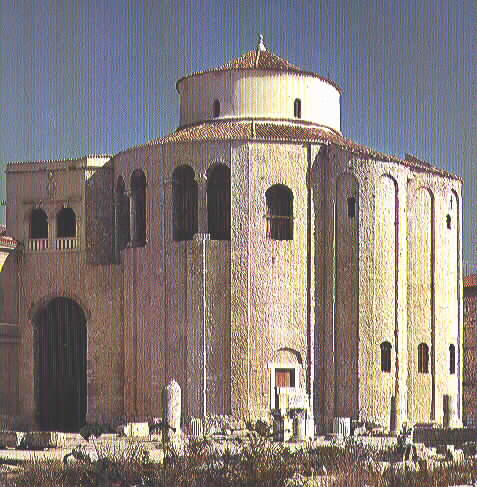
One of the most important monuments of the Pre-Romanesque architecture in Europe is the Church of St. Donat in Zadar built in the 9th century. According to [Goss, p 92], a discovery of wooden beams in this monumental church, adorned with interlace, datable by carbon method to around 710, indicates that this building, often referred to as “Carolingian”, was well-under construction in the course of eighth century.
Truly fantastic stone monuments with interlace patterns were found in Dubrovnik and its environs, see [Menalo]. See also another Croatian interlace in the cathedral of St. Tripun of Kotor in Boka kotorska.
Monolithic
stone grave monuments,
called stechak
(literally – standing tombstones), are very
impressive, some of them weighing 30 tons, the earliest of them dating
from the 13th century. Their overall number is more than 66,000, mostly
on the territory of Bosnia-Herzegovina. There is no doubt that such
monuments were put up by Catholics and Krstyans
(members of a local Christian religious sect in Bosnia) during the
Middle Ages. The origin of Krstyans is still not clear. Some of the
stecaks have interesting decorations, some even swastika and other
symbols and ornaments of eastern provenance, with epitaphs like: Please,
do not disturb me,
I was like you, and you will be like me…
written in the Croatian Cyrillic alphabet. The most widespread ornaments are Christian symbols.
Examples:
| richly ornamented Zgosca stechak (15th century?), held in the Sarajevo Archeological Museum. | A stechak near Dubrovnik: |
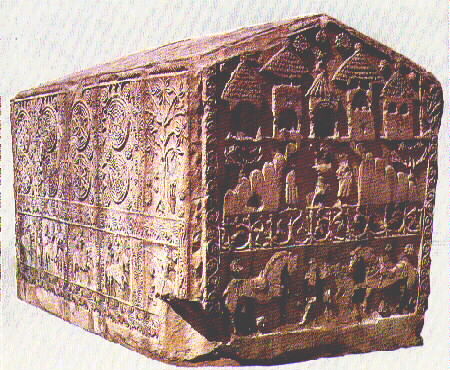
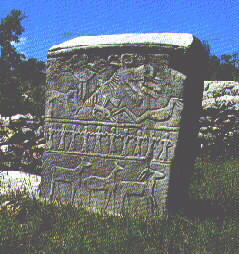
A few more examples are here.
The first documents of the Croatian Cyrillic alphabet are inscriptions carved in stone in present-day Bosnia-Herzegovina dating from the 10th or 11th century (Humacka ploca) and on the Croatian island of Brac from the 12th century. They also contain some glagolitic letters. Many written documents concerning medieval Croatia contain simultaneously three Scripts, thus proving their unexclusiveness and coexistence, which is unique in the history of European culture. For example some of the religious texts end with `Amen’ written three times: in the Glagolitic, Cyrillic and Latin script. Apart from the parallel use of the three Scripts, unique is also the simultaneous use of three languages – Croatian, Latin and Church Slavonic.
Juraj Culinovic (1435-1504), Croatian Renaissance painter, was active in his native town of Sibenik. Except in Croatia, his polyptichs are kept also in Torino, London (National Library), Berlin and Venice.
The city of Karlovac was built in 1579 as the first ideal Renaissance fortification in Europe (then followed Nove Zamky, Palmanova, Neu Breisach). It was bombed during the Greater Serbian aggression in 1991-95.
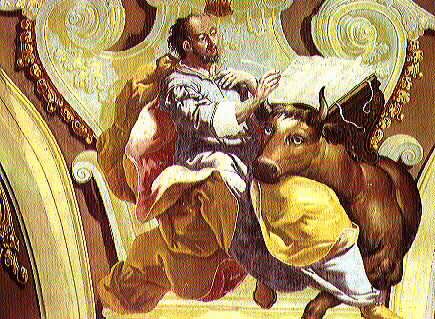
Many beautiful Croatian Baroque paintings and illuminations can be seen on the walls of the churches in north-western Croatia (Lepoglava, Strigova, Varazdin), created by Ivan Ranger (1700-1754). On the photo: St. Luka (Strigova).
The
Baroque art in the Croatian north is
described by a famous Japanese photographer [Keiichi
Tahara]:
Quand un ami française m’a conseillé d’aller voir les églises baroques en Croatie…je n’ai pratiquement rien trouvé sur ce sujet. Cela m’a paru étrange, et j’ai cédé à la tentation…
One of the greatest Croatian Baroque painters was Tripo Kokolja (1661-1713), born in the town of Perast in Boka kotorska (since 1945 in Montenegro).
Here we mention a French artist Charles François Beautemps-Beaupré, who prepared a superb collection of drawings of Croatian coast in his atlas entitled Reconnoissance hydrographique des ports du Royaume d´Italie situés sur les côtes du Golphe de Venise commencé en 1806 par ordre de sa majesté Napoleon. 1806. It contains 15 hand-drawn maps of various sizes, 2 sheets of coastal contours, water colour drawing. This unique Atlas, kept in the National and University Library in Zagreb, is according to presentation given by the British Library (follow the above link) of outstanding artistic and scientific value, and is a contribution to the scientific, cultural and historical accounts of the Croatian coast.
Vjekoslav Karas (1821-1858): Roman Lady with a Lute, one of the most famous paintings of Croatian fine art from the middle of the 19th century… His parents are Bosnian Croats.
Other outstanding painters were:
- Vlaho Bukovac (1855-1922); He worked in Paris from 1866-1893. In 1888 he visited England, made many friends and painted countless portraits of the members of various families, into which he was received as a friend and guest. His picture “Potiphar’s Wife” was exhibited in the Royal Academy of London and in Birmingham. He was also a professor at the Academy of Art in Prague from 1903 to 1922.
- Celestin Medovic (1857-1920),
- Ljubo Babic.
The best Croatian representatives of `arts plastiques’, acting in Paris, were:
- Vladimir Becic (1886-1954),
- Miroslav Kraljevic (1885-1913),
- Josip Racic (1885-1908).
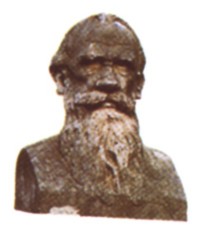
It will be interesting for Russian readers to know that the earliest monument built in honour of the famous writer L.N. Tolstoy (1828-1910) was erected not in Yasnaya Polyana, but in Selca (1911, a year after his death), a small and lovely town on the island of Brac, which has a great tradition in stonemasonry.
In the beautiful stone church in the town of Selca on Brac, there is Mestrovic’s bronze statue of Jesus Christ, with a heart in his hand – symbol of love and peace. This statue, a gift of Ivan Mestrovic, was made from large amount of artillery shells left by German troops on Brac after the WW2.
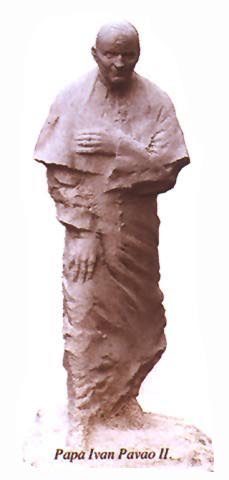
In
1996, Selca
erected a monument to a great pope,
John Paul II,
out of gratitude for his concern for the Croatian people.
Josip Crnobori (1907-2005)
Ferdinand Kulmer 1925-1998 distinguished Croatian painter author of Croatia Phoenix series in 1991
Velimir Trnski, oustanding Croatian painter
What Louvre is for Paris,
- the Mimara Gallery is for Zagreb – it has a very rich collection, from classical Chinese art to the Impressionists. It is a donation of Ante Topic-Mimara. We should also mention
- Strossmayer’s Gallery and
- the Art Pavilion in Zagreb.
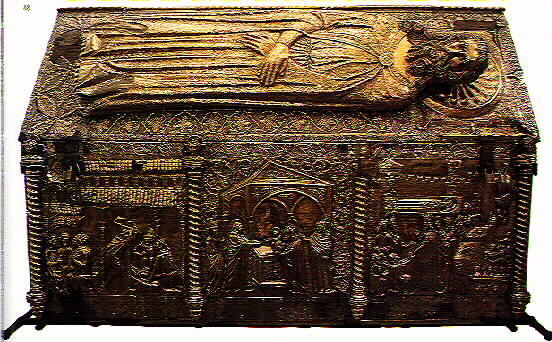
Here
you can see a reliquary chest of St Simun,
created by the goldsmith Francis of Milan in 1377-1380, made on order
of Elizabeta,
daughter of Bosnian Viceroy
(ban) Stjepan Kotromanic and the wife of Croatian-Hungarian King Louis
Anjou. It contains 200 kg of silver and 50 kg of gold, and is held in
the church of St Simun in Zadar. No doubt, the most interesting gallery
in Zadar
is the Benedictine Gallery of
Gold and Silver, which contains
numerous artifacts from 11th century onward, all of them created in
this ancient town. It is indeed amazing that the artifacts have been
saved during the ferocious bombing of the Allies in 1943/44, when the
city, a jewel of Croatian history and culture, was 90% destroyed for
the reasons that we still do not know. The Benedictine convent
of St Mary, where the Gallery is situated, founded in 1066
during the reign of the Croatian
King Kresimir IV (i.e. in time
of William the Conqueror), has been active without interruption till
these days! For additional information about Croatian art in Zadar see here.
Some
Croatian cities in Dalmatia have been
described by William Wey, a teacher at Eton, during his pilgrimage to
the Holy Land in the 15th century. He was impressed by Dubrovnik,
Rovinj, and, especially, by Zadar where “lies the entire body of St
Simon who, in the temple of Jerusalem, carried Christ in his arms”.
The Mestrovic gallery in Split is also famous.
Several important galleries of the city of Vukovar have been robbed in 1991 and the stolen exhibits and works of art are still held in Belgrade, capital of Serbia:
- The Gallery of Vukovar, a donation of Antun Bauer, was very rich.
- Treasury of Franciscan Church of St Phillip and Jacob in Vukovar
- Museum of Nobel Prize winner Lavoslav Ruzicka
- The Eltz Palace, museum with artifacts of the famous Vucedol Neolitic culture.
Twenty trucks were brought from Belgrade to Vukovar in December 1991 to plunder the City Museum in Vukovar, as well as the Gallery and the City Library, under the auspices of Belgrade curators. The Vukovar Gallery was left completely empty. One expects the Serbs to return 1648 stolen works of art of outstanding Croatian artists, that belonged and still belong to the Gallery of Vukovar. This is only a part of the overall number of about 10,000 stolen works of art from several Vukovar museums and galleries that are now held in Belgrade and Novi Sad. Till now not a single work of art has been returned. (Personal information by dr Bauer, on this web with his kind permission.) … The above mentioned stolen works of art were returned to Vukovar only in 2002, in such a shape that it will require a lots of further financial and other effort from Croatia to restore it, since it was held in inappropriate conditions in the new Yugoslavia during more than ten years.
We know that a part of this very important Croatian cultural heritage has already been sold in Western Europe. We also know of unsuccessful attempt of Belgrade cultural representatives to exhibit in France this stolen Croatian cultural heritage as Serbian.
Aleksandar Antoljevic Zvjagin, outstanding Russian painter living in Croatia, created beautiful masterpieces for Croatian churches and convents both in Croatia and in Bosnia-Herzegovina. See for example his St Francis taming a wolf, kept in front of the famous Franciscan monastery on the islet of Kosljun near the town of Punat on the island of Krk.
Sarah Bernardt
visited Zagreb twice, in 1889
and in 1904, with La Tosca
and La dame aux
camélias,
performed of course in French. Also according to [Dolbeau]
she had several visits to Zagreb. Is it true that Émil
Zola
had Croatian roots, as claimed by the French intellectual Cristophe
Dolbeau, see p 47 (Colich -> Zola)? The French writer George
Sand
wrote her novel “Uscoque” (Uskok) in 1838, Prosper Merimée
wrote
his famous “Guzla” in 1827, both obviously inspired by Dalmatia and its
inhabitants. The French writers were extremely popular in Croatia in
the 19th century.
French
universities allocated about 600
scholarships to ex-YU students each year between the two WWs. Here the
Croatian students were represented with only by 5, i.e. with less than
1% (one percent). Despite this, in the same period more than 100 French
authors were translated into Croatian by Zabavna biblioteka led by
Nikola Andric in Zagreb. See [Gregory Peroche],
p. 210.
In Zagreb alone, in the period from 1919 to 1980, there were near two thousand performances of Shakespeare’s dramas (exactly 1940 performances: Hamlet, 654; Twelfth night, 252, A Midsummer Night’s Dream, 189; Othello, 132 etc.). They were put on in Zagreb already in the 19th century.
Zagreb also hosted the great Shakespeare interpreter Laurence Olivier, with the guest performance of Titus Andronicus by the London Old Vic (1934).
You can see the home page of the Blind Theater Company – “NEW LIFE” (NOVI ZIVOT) founded in 1948, and until 1986 the only blind theater company in Europe, when several new Blind Theaters appeared. That is why Zagreb will have the honour to organize The first European festival of Blind Theaters in 1999.
The King of Dolls! – Since 1991 an invaluable collection of more than 350 dolls owned by Mr Ljeposlav Perinic, Argentina, is in Zagreb, Croatian capital. Dressed in picturesque national costumes from over 100 countries, these dolls represent gifts of many statesmen to Mr Perinic. He collected them for more than 30 years.
Vlado
Kristl (1923-2004),
der Filmemacher, Maler und Dichter… Der in
Zagreb geborene und seit Jahrzehnten in Deutschland lebende
Multikünstler galt als “Anarchist der Fantasie”. Radikal und
konsequent hatte er sich zeitlebens allem Kommerziellen widersetzt und
bewusst gegen den Strom gesteuert.
Mit Filmen wie “Der Damm” oder “Der Brief” hatte Kristl großen Anteil am “Neuen deutschen Film”. An der Kinokasse erwiesen sich Kristls Leinwandexperimente, bei denen die Einstellungen ohne jeden Bezug zueinander gedreht wurden und Beziehungen erst durch den Schnitt und die Montage zu Stande kamen, als wenig erfolgreich. Auch in späteren Werken wie “Film oder Macht” und “Obrigkeitsfilm” stand Kristls Kino für Subversion und gegen alle historischen Konventionen der Filmerzählung.
Eine der letzten größeren Arbeiten war 1998 der Streifen “Der letzte Klon”. Filmkenner lobten vor allem Kristls Radikalität und Konsequenz (…)
Source: Hommage á Vlado Kristl: Roswitha Pross / Michaela Dietl / Carola Regnier / HMR Praetorius, München