Ivan Mestrovic
In the fine arts of our time probably the most famous is the sculptor Ivan Mestrovic (1883-1962), who created masterpieces, many of which are dedicated to the history of his motherland. You can see them in the Mestrovic gallery in Split and in Croatian capital Zagreb. He also created
- the bust of Cardinal Alojzije Stepinac, New York (Croatia Place, Lackawanna),
- the grand “Monument of the Unknown Soldier” and “The Monument of Gratitude to France” in Belgrade,
- the beautiful Mausoleum of Petar Petrovic Njegos, Montenegrin poet and statesman (Lovcen in Montenegro),
- “The Well of Life” in Zagreb,
- “History of the Croats” (Povijest Hrvata, symbol of the University of Split), whose several copies are held in Croatia, while the original is in Belgrade (!), capital of the new Yugoslavia. He planned it to be situated in the “Museum of Croatian Antiquities” in Split. One expects the Serbs to return this important monument to Croatia.
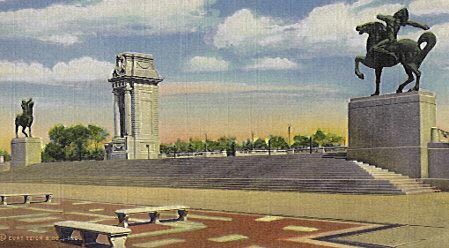
His sculptures can be seen in London (Tate Gallery), Florence (in “Uffizi”), Torino, Rome, Prague (in Hradcany), Budapest, Chicago (Chicago Indians, Grand Central Park, see a postcard on the right from 1939 and two photos below), South Bend (Indiana, USA), Rochester (Minnesota, USA), Baton Rouge (Louisiana, USA) etc. He also carved a monument of the most outstanding Slovak writer Martin Kukucin (Matej Bencur) in Punta Arens (Patagonia, Argentina). Matej Bencur spent a part of his life in Croatia on the island of Brac and wrote a book about the life of the Croatian emigrants in South America.
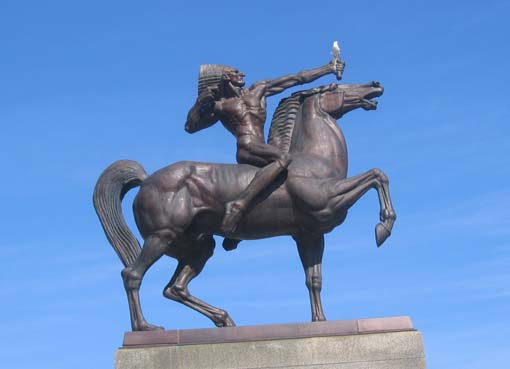
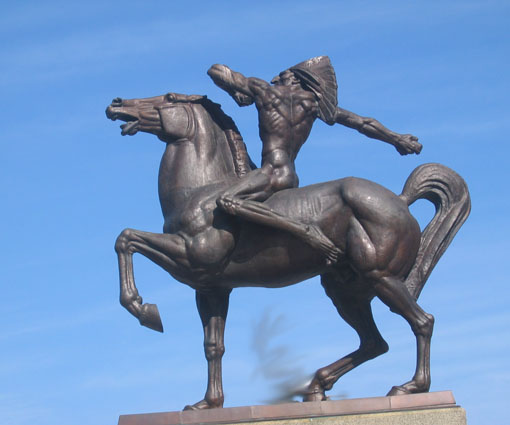
Mestrovic’s Chicago
Indians were cast in the
city of
Zagreb,
capital
of
Croatia
Mestrovic’s 1939 sculpture representing Croatian ban and bishop Petar Berislavic (killed by the Turks in 1520) was exhibited on the central square of the city of Trogir. During the Italian Fascist rule the sculpture was destroyed. In 1970 a replica has been installed on the same place. Petar Berislavic was a close friend to a famous Croatian writer Marko Marulic, who described his tragic death.
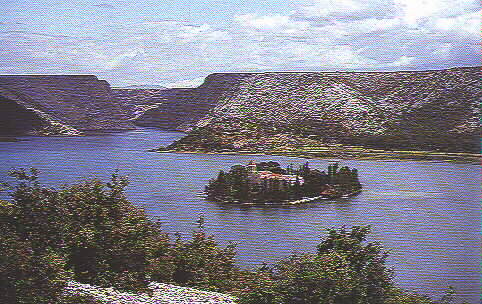
The grave of Mestrovic was desecrated by the Serbs in his birthplace Otavice during the 1991-1995 occupation of the Krajina region. Some of the original pieces of art from the Mestrovic Mausoleum were damaged, and some were stolen and transported to Belgrade. The remains of “The Monument of Gratitude to Motherland” can be seen in the beautiful Visovac Monastery on the river Krka.
|
Mother teaching her child to pray, New York, 1925 |
Autoportrait, |
Autoportrait, Zagreb, 1930 |
|
My mother with crossed hands, Zagreb, 1926 |
A young girl in prayer, 1925 |
Njegos mausoleum, Montenegro |


Photos from the booklet Spomen galerija Ivana Mestrovica, Vrpolje. Mestrovic was born in Vrpolje on the north of Croatia in 1883, where he spent his first year of life.
Ivan
Mestrovic:
ON RELIGIOUS ART (1954),
excerpt: “…The head of that
suffering Church is Cardinal
Stepinac, my
compatriot, my dear friend, of whom I and all Croats are proud. I am
sure that our feelings are shared not only by all the Catholics
throughout the world but also by all men of goodwill everywhere who
cherish freedom of spirit…”
Please, do not miss the following deep thoughts of Ivan Mestrovic, as if written today (taken from Zeljko Skropanic web site, see the complete text):
There are more and more people today who have come to the conviction that one of the main causes of the tragic events of the recent past, as well as those which loom on the horizon, is the fact that modern man has all but forgotten the great teachings of the Sermon on the Mount [The Bible, Mathew 5-7]. The blame for this rests not only on our contemporary despotism, but, unfortunately, on a long list of talented men of science and art who have not foreseen the corroding complications and destructive consequences of their doctrines. This atmosphere of unbelief, this tragic state of man cut off from the very axis which holds and moves everything, has had repercussions on all domains of human activity, including that of art, which in the most significant periods of civilization worked hand in hand with religion – an ennobling and spiritualizing factor in human life.
Christian civilization, in our days, finds itself locked in a mortal struggle with the forces of secularism in varying forms and degrees. Many people fail to realize that Christianity, by waging the fight for its principles, defends also the foundation of the democratic way of life; for the concept of the dignity of each man and the equality of all men stands and falls with the Christian view that man is created in the image of God. Thus the Church is in the front lines of the battle against the onslaughts on human freedom. A moment ago, I mentioned my wood carving of the scene of the Crucifixion. The piece of wood on which I carved the Crucifixion has an interesting story which I would like to share with you. I was in Geneva, Switzerland, when I was seized by the desire to carve the Crucifixion. Every available oak had been bought by the factory that manufactured rifle buts, presumably for both warring sides. I had a hard time to acquire from the factory a few boards for relief. I was unable to get the whole piece of the trunk because they had all been sawed up. Finally, I discovered one trunk that had not been sawed off; it was withered and had stood with its roots in the soil and was not considered good for rifles because it was assumed that the wood was probably decayed. When I started to work on it, I discovered that it was solid and whole. The lumberman told me that it had been imported. I was surprised to learn that it had come from Croatia, my native country. That same piece of wood was later returned to Croatia, transformed into the Crucifixion scene. Today it stands there, in a small Chapel, in the country where the Catholic Church is being crucified daily. The head of that suffering Church is Cardinal Stepinac, my compatriot, my dear friend, of whom I and all Croats are proud. I am sure that our feelings are shared not only by all the Catholics throughout the world but also by all men of goodwill everywhere who cherish freedom of spirit In vain do the Godless and restless men, who are today making weapons in the hope of enslaving the world, think that the trunk of the Christian tree is withered. It will outlive and outlast the forces of evil in my native land and throughout the whole world. He who has conquered death will conquer the destruction of His teaching.
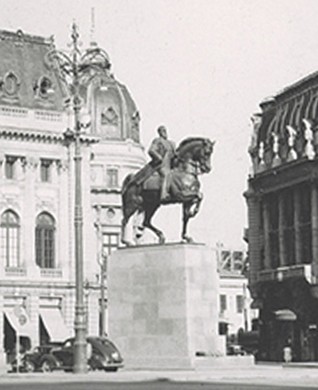
Mestrovic’s equestrian statue of King Carol I of Romania in Bucharest was removed by the communist regime.
One of Mestrovic’s major works is Moses, the monument donated to the people of Israel.
Silver Proof €15 coin celebrates the 80th anniversary of the original coin design Girl with Harp which was gifted to the Irish State by Ivan Mestrovic in 1927. This design was submitted by the artist as an entry in the competition for the design of the 1928 Irish Free State coinage. Unfortunately, because of difficulty contacting him (he was in the United States) his design arrived too late for consideration. The Chairman of the Design Committee, a famous Irish poet William Butler Yeats, subsequently wrote “He made one magnificent design and, on discovering that the date had passed, gave it to the Irish Free State with great generosity”. It has been used as the seal of the Central Bank of Ireland since 1965. Alongside the €15 Silver Proof Coin being issued in Ireland, there is an almost identical 150 Kuna Silver Proof Coin being issued by the Croatian National Bank. Both coins bear an identical obverse, the beautiful “Girl with Harp” design by Ivan Me±trovic. (source: Central Bank of Ireland)
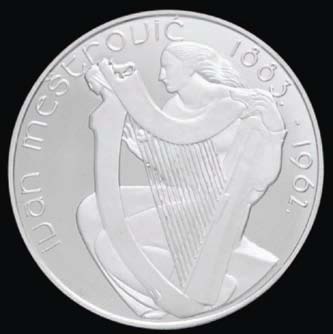
Both Irish and Croatian coins minted by Croatian Mint
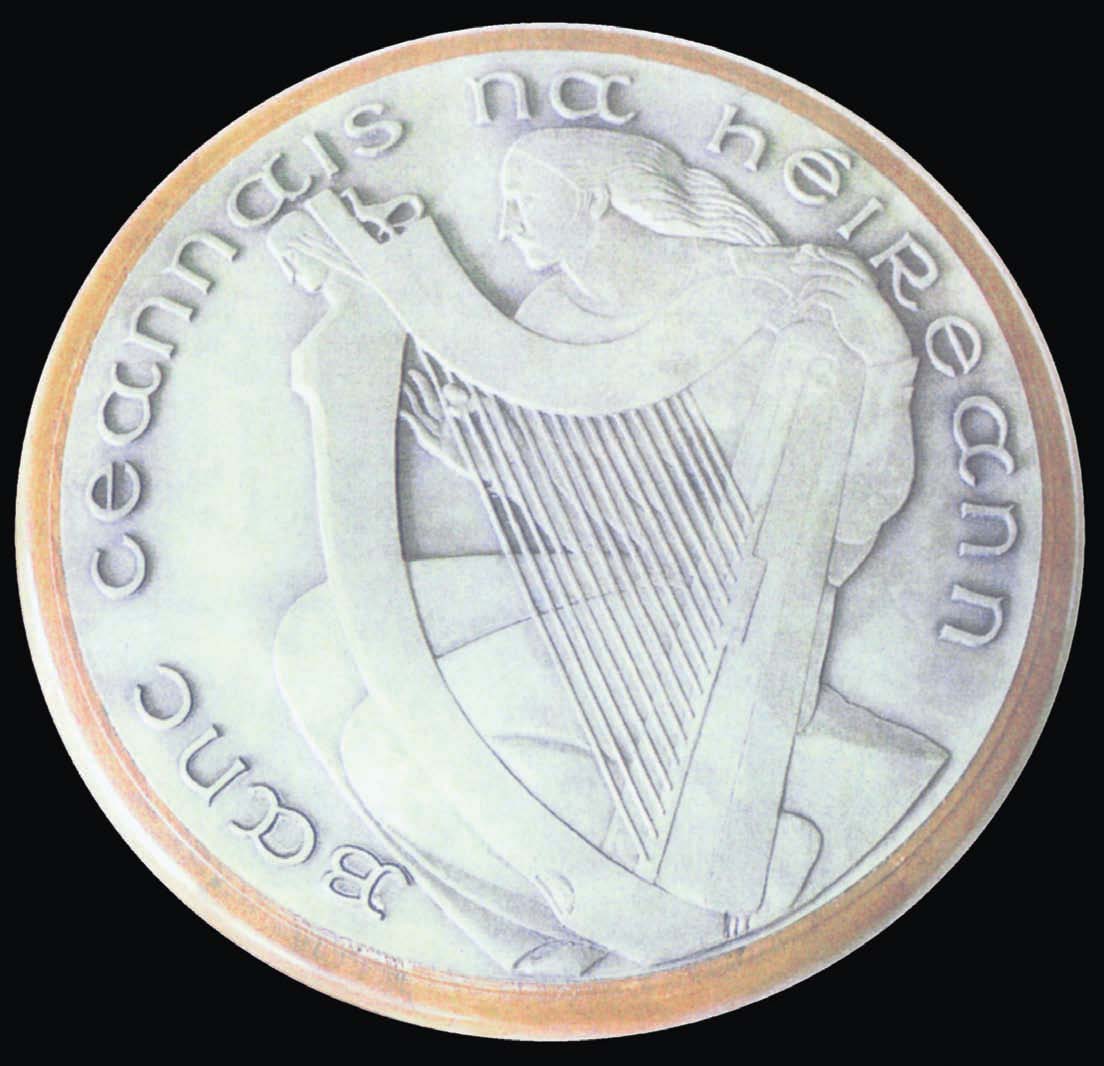
For more information see Ivan Mestrovic Silver Coin [PDF], Hrvatska narodna banka
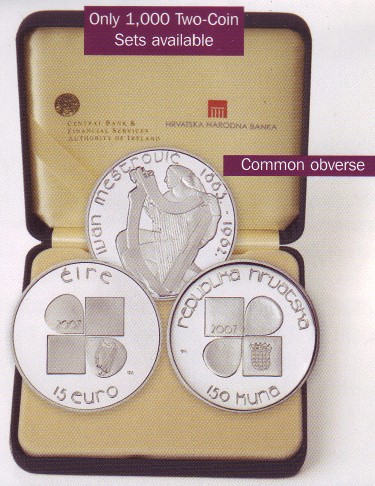
The double box set limited to 2000 overall, 1000 to Ireland and 1000 to Croatia
In 1928 Mestrovic sent four recommendation letters to his influential friends in Croatia in which he asked to help the Croatian Youth Society BUNJEVAC from the city of Subotica to visit the land of their grandparents – Dalmatia and Herzegovina. As he stated, Bunjevci Croats in Baccka have preserved the character of their grandparents in their ikavian speech and customs. See “Marulic”, 5/1998, 908-911.
In 1954 Mestrovic became a citizen of the United States at a ceremony conducted by President Eisenhower at the White House. See his daughter’s article.
The white marble from the island of Brac, near the town of Pucisca, is highly appreciated among sculptors. It was also used in the building of
- the White House in Washington,
- the Battary park in New York
- the Austrian Parliament and the New Palace in Vienna,
- the Hungarian Parliament in Budapest,
- the White court in Trieste, Italy,
- hotel Panorama in Prague, Czechia
- many embassies in Belgrade, Yugoslavia, still in use today, etc.
The first monument honouring Mother Teresa was carved in Supetar on the island of Brac (2002). It was unveiled by Martin Sheen.
