Naive art
Naive art is quite widespread and highly esteemed. The first steps were undertaken by the painter Krsto Hegedusic (1901-1971) in the Croatian village of Hlebine. It was the famous Hlebine school. Hegedusic also founded a group of artists called “Zemlja” (Earth) in Zagreb in 1929, which has been forbidden by the Yugoslav (Serbian) police in 1935. From a large number of naive painters, whose creations decorate private and state collections from Paris to Tokyo, let us mention only a few:
- Ivan Generalic (1914-1992)
- Franjo Mraz
- Mirko Virius
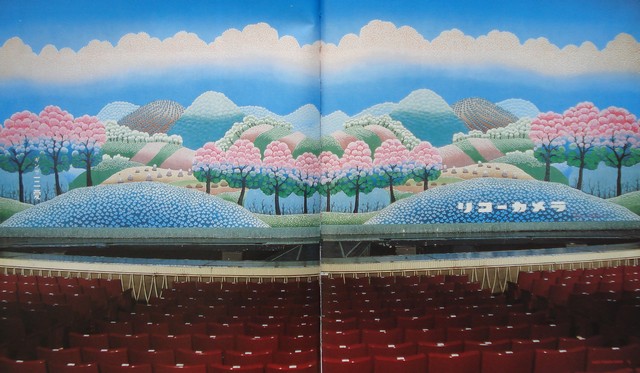
- Ivan Rabuzin (1921-2008) – designed a curtain decorating the stage of one of the best Kyoto theaters (Japan), as well as the Takarazuka Theatre in Tokyo (10.5 x 24 m, 1980), and several other museums in Japan: Sategaya Art Museum in Tokyo, Saitama Museum of Modern Art in Urawa, Isetan. A detial from Ivan Rabuzin’s drop curtain in Takarazuka Theatre in Tokyo. Photos from Croatia, homeland of Marco Polo, Croatian national tourist board, 2008. The above mentioned ceremonial drop curtain at the Takarazuka theatre in Tokyo was produced by the Heizo Tatsamura Institute, Textiles Arts Kyoto, in 1979 and 1980. Twenty four weavers were working for three months to make it. Among other materials, 30 kg of gold thread was used. M. Shiro produced a film about Rabuzin’s ceremonial drop curtain. This information is from Croatia, homeland of Marco Polo, Croatian national tourist board, 2008. He also had exhibitions at Daimaru and Shinsabashi in Osaka. Since 1976 his designs are used by “Rosenthal”, renowned producer of porcelain ware. He is also a member of the Croatian Parliament (Sabor). It is interesting that Rabuzin’s father was a miner, while his mother was blind. His art was exhibited throughout the world: Zagreb, Paris, Antibes, Zurich, Milano, USA (Louisiana, Smithsonian Institution, Carnegie Institute Museum of Art, Scottsdale Center for the Arts, Milwaukee Museum Art Center, Chicago Public Library, C.W. Post Art Galery/Long Island University, Pittsburgh), Oslo, Munich, Dusseldorf, Amsterdam, Verona, Brescia, Florence, Tokyo, Osaka, Geneva, Cologne, London, etc. As many as 10 films have been made about Rabuzin’s work, including one in Japan (Moritani Shiro, Kyoto). Among 13 monographs devoted to his work we mention only the following one: Masayoshi Honme, Ivan Rabuzin / Taiji Harada, 1990, published by Kodanasha, Japan.
- Mijo Kovacic (1935)
- Ivan Lackovic – Croata (1932-2005)
- Ivan Vecenaj
Croatian Museum of Naive Art, Zagreb

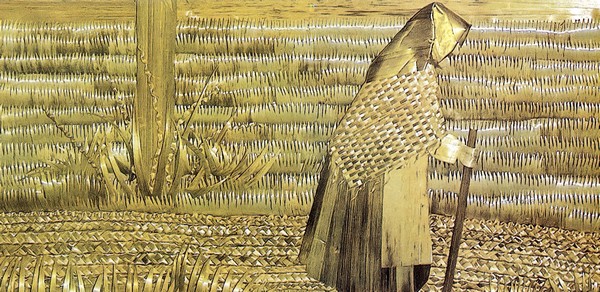
Very interesting are are naive artists called slamarke from Tavankut (and also in Subotica) among Bunjevci Croats in Backa on the north of today’s Yugoslavia. The name slamarke is derived from Croatian name for slama = straw. They use straw weaving for beautiful and poetic description of their life on salas, a small oasis with a hut on immense panonian golden plain full of cereals, with several trees and unavoidable djeram – an old type of well (see on the right). A very common motive are small Catholic churches and Christian symbols. I adore this type of art. At the 1976 international exhibition of naive art in Moscow Ana Milodanovic won the gold medal with her work with straw weaving. Also, Kata Rogic had exceptional honour to present her work to Pope Paul the VIth.