Maximilian (Maxo) Vanka
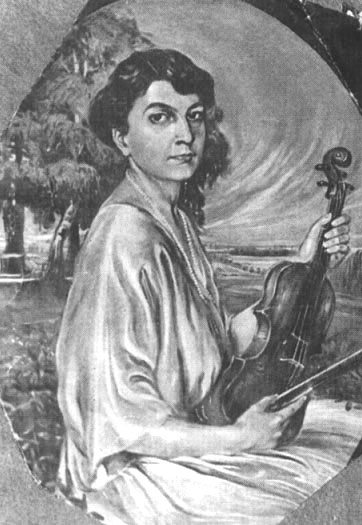
Croatian painter and muralist Maximilian (Maxo) Vanka (Zagreb 1889 – Mexico 1963) completed his studies at the Academy of Fine Arts in Zagreb, where later he became professor of painting. He also studied at the Brussels Academy of Fine Arts, Brussels, Belgium. As a young student he exhibited at an international show in the Belgian capital and in 1914 won the gold medal of King Albert at this event, for his Bistricki prostenjari (Marija Bistrica fairgoers) with beautiful Croatian folklore motives. He made a nice portrait of Croatian female composer Dora Pejacevic (1885-1923):
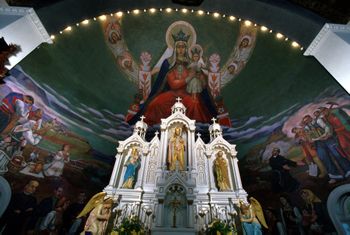
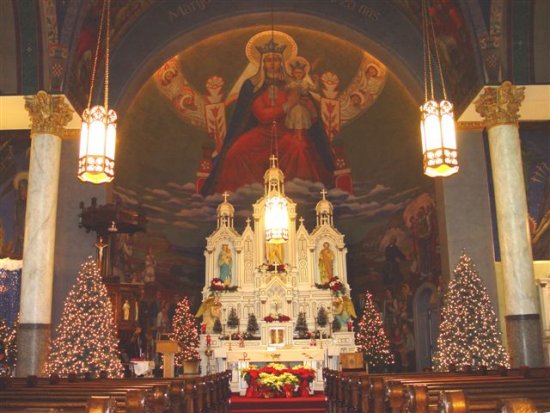
Vanka exhibited throughout Europe, and obtained many honours, among them Palme Academique of the French Legion of Honor. Having moved to the USA in 1934, he became noted for his beautiful church murals, for example in St. Nicholas Croatian Church, Pennsylvania. Some american specialists consider these murals the best church frescos in the USA. He depicts not only traditional Catholic scenes and symbols, but also the lives and spirituality of the Croatian immigrant community.
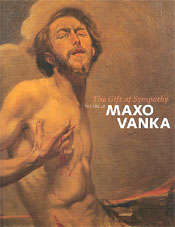
Vanka founded the art department at Delaware Valley College of Science and Agriculture in New Britain, Pennsylvania. After his tragic death (drowned in the Pacific) a bird sanctuary was established in his honor at the Washington Crossing Nature Education Center.
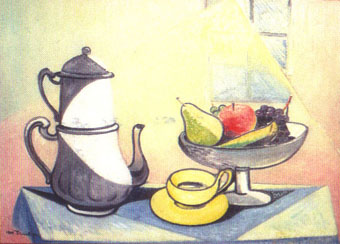
According to Croatian art historian Nikola Vizner, most of his works are in possession of his family in Bucks County, Pennsylvania; the Michener Museum in Doylestown, PA has a formidable collection of his works; there is a large collection of his work in Modern Gallery, Zagreb, Croatia, as well as in the Memorial Museum Maximilian Vanka in the town of Korcula (on the beautiful island bearing the same name), Croatia. Here is Vanka’s philosophy of painting:
|
I
painted so that Divinity in
becoming human, would make humanity divine. |
His main interests were in folklore and social motives, human destiny in general. One of his deeply moving masterpieces is Lepers, a result of his short stay in India.
|
From Pitsburgh History
(an excerpt): In Millvale, at
St. Nicholas Croatian Catholic Church, one very unusual wall mural
blends religious and political themes to express a strong personal
message from its artist, Maxo Vanka, a Croatian artist who fled to the
U.S. in the mid-1930’s. On the ceilings and walls of St. Nicholas,
Vanka painted Jesus’ mother weeping at the Crucifixion; a Croatian
mother weeping as she raises her sons for war; an immigrant mother
weeping as she raises her sons for hard labor in the manufactories; and
the famous statue of Injustice wearing a gas mask. On the ceilings
below the choir loft he painted images of war, mixing images of Christ
with 20th Century soldiers, and at the back, a greedy capitalist
sitting at a table ignoring a beggar at his feet.
Mary, Queen of Croatians,
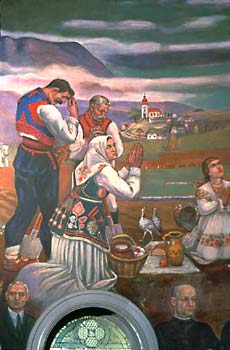
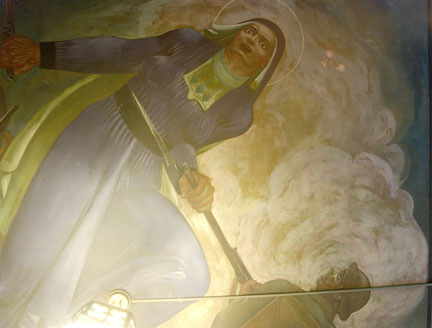
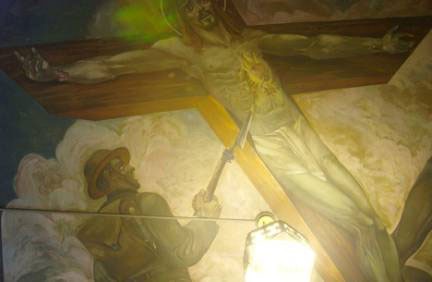
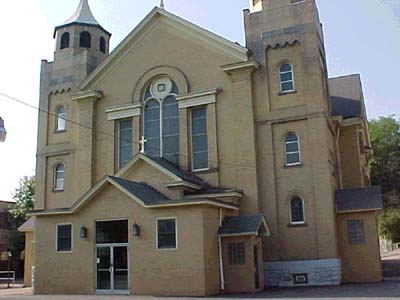
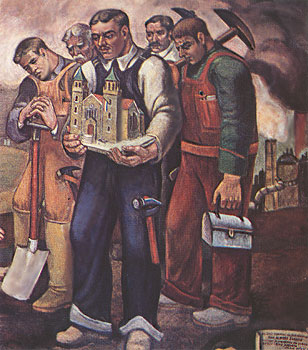
pray for us! – Marijo, Kraljice Hrvata, moli za nas! www.stnicholascroatian.com The controversial commentary on social classes and injustice sparked debate at the time, and a prominent Pittsburgh family even offered one million dollars to the Diocese to whitewash what they felt was a personal attack. The offer was refused, and today the controversial images still exist along with Vanka’s more pastoral images depicting rural life in a Croatian village. In those less provocative mural images, people are dressed in traditional Croatian costumes, and they dance by a sea that “flows” into the hills of Pittsburgh, surrounded by a painting of the parish priest and the immigrants who helped to build the church. Maxo Vanka told the story of Croatia’s tragic heroes through war, and immigration, and work on the walls of St. Nicholas Croatian Catholic Church in Millvale. These murals are definitely not just for decoration like the murals in homes. What story do they tell? See here. David Byrne (member of rock group “Talking Heads”, New York): …The church is Croatian and the murals, by Maxo Vanka, are spectacular — the Diego Rivera of Pittsburgh, I would say. The murals were done during eight weeks in 1937, and they cover the interior of the church. Of course there is the Virgin holding the child, but below her, for example, on each side of what is now the altar, are Croatian people, on the left from the Old World, and on the right from the New. A steel foundry can be seen belching smoke behind them. But more amazing are the political murals that echo the crucifixion. Widows mourn over a soldier in a coffin containing a bleeding corpse; crosses cover the hillside behind them. Another wall depicts a corrupt justice in a gas mask holding scales on which the gold outweighs the bread. Clearly World War II had a big effect on Maxo. The Virgin, on the verge of being bayoneted herself, separates two soldiers. Maxo Vanka mural. Photo by David Byrne. On another mural an oligarch done as Death reads the stock reports while being served a chicken dinner by two black servants. One more: Jesus is stabbed, a second crucifixion. Maxo Vanka mural. Photo by David Byrne. These are badly in need of renovation; probably years of coal dust have darkened them. But one can hope that these amazing things will survive and be cleaned soon. St. Nicholas was established as a Croatian parish in 1900. The origin of the parish can be traced to the influx of Croatian immigrants to the area to work in local industries in the late nineteenth century… Mural of Croatian workers offering St. Nicholas Church to the Holy Mother, 1938 Mural of the Pieta, 1938 Mural of the Crucifixion, 1938 “The Immigrant Mother Raises Her Son for Industry”, 1938 Mural of pastoral Croatia, 1938 Mural of the Croatian mother raises her sons for war, 1938 St. Nicholas Church, 2002 Church murals depicting spiritual, cultural lives of Croatian immigrants draw renewed attention A portion of Maxo Vanka’s 1937 mural “The Croatian Mother Raises Her Son for War.” “The Immigrant Mother Raises Her Son for Industry” by Maxo Vanka is based on a mining accident in Johnstown. “Croatian death in Pennsylvania”, by Maxo Vanka “Faith of Croatian workers in the USA” by Maxo Vanka |

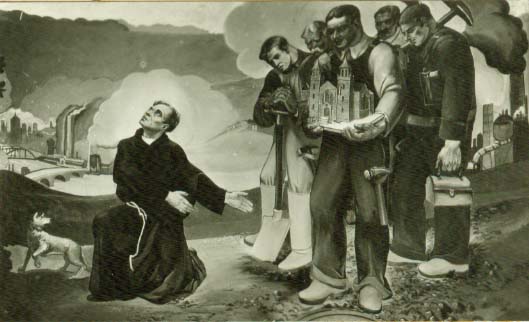
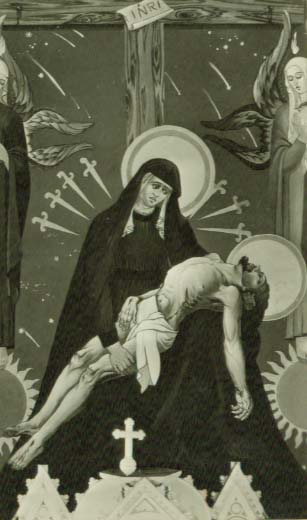
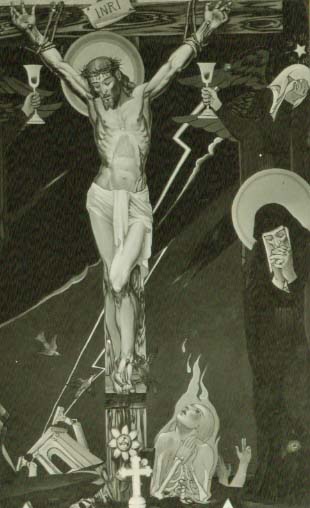

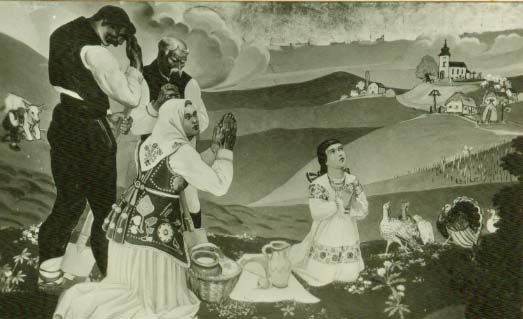

Peggy Vanka Brasko: It was well known that my father [Maxo Vanka] worked at painting the murals at a furious pace. He usually worked between 16 to 18 hours daily through the entire week. He worked without a watch so as not to be influenced by the time of day. …
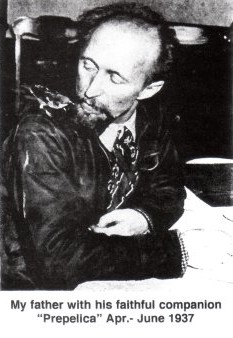
Peggy Vanka Brasko: …I most love the picture of him with “Prepelica” the little sparrow [quail] that he nursed back to health after he found it with a broken wing. It became a constant companion as he painted the murals. It tells something about his special intuitive touch which he called “the gift of sympathy”. I am so much my father’s kid! (and mother’s too!) With much love to all of you, Peg
The Murals at St. Nicholas Parish: …Today they stand as a moving tribute to the people of Croatia, the Croatian immigrant and all immigrants to the United States. They are among the most striking and provocative murals found anywhere in the world. Maxo Vanka’s twenty murals, combined with a more contemporary and complimentary mural by J I Knezevich, form a unique church artwork that combines secular and ecclesiastical images with startling interpretations of 20th century historic events.
Maxo Vanka was a good friend to Andrija Stampar, a famous Croatian phisician, father of the World Health Organization (WHO).
You can support the work
to preserve the murals through
the Society to Preserve the Millvale Murals of Maxo Vanka.
Please write for more information to:
The Society to Preserve the Millvale Murals of Maxo Vanka
c/o Diane Novosel Chairperson
151 Stone Gate Drive
Leechburg PA 15656-7228
Personal and group tours of the murals can be arranged by calling:
- Diane Novosel – 1.724.845.2907
- The Parish directly – 1.412.821.3438

For additional information see
Maxo Vanka, a famous Croatian painter
The Society to Preserve the Millvale Murals of Croatian painter Maxo Vanka
http://vankamurals.org/
https://www.youtube.com/watch?v=0m546dcV7Qw
https://www.youtube.com/watch?v=BDLSZmJ_Tf0
https://www.youtube.com/watch?v=lUD5_z-aPXY
https://www.youtube.com/watch?v=9VFiw4t8QW8
http://www.wiki-dveri.info/wiki/Maksimilijan_Vanka
- Dupor, M. Korčulanin Vanka, Zbornik otoka Korčule. Sv. 2(1972), str. 179-182.
- Laljak, S. Tajna slikara Maksa Josipa Vanke, Zaprešićki godišnjak 1997.: za grad Zaprešić i općine Brdovec, Bistra, Dubravica, Luka, Marija Gorica i Pušća, uredio Stjepan Laljak. Zaprešić: Matica Hrvatska Zaprešić, 1998. Str. 147-149.
- Maksimilijan Vanka. Akademija likovnih umjetnosti u Zagrebu. Zagreb, 2002. str. 222-223
- Maksimilijan Vanka. Katalog izložbe Maksimilijan Vanka, Galerija Klovićevi dvori, Zagreb 2002.